
How to Simplify Your Daily Beauty Routine: 7 Steps
Table of Contents
- Step 1: Audit Your Current Beauty Collection
- Step 2: Build a Three-Step Skincare Foundation
- Step 3: Swap in Multi-Purpose Beauty Products
- Step 4: Learn How to Create a 10 Minute Makeup Look
- Step 5: A Minimalist Makeup Routine for Beginners
- Step 6: Cut Back on Exfoliation and Let Skin Rest
- Step 7: Keep Your Routine Sustainable and Budget-Friendly
- Frequently Asked Questions
Last Updated: September 13, 2026
Step 1: Audit Your Current Beauty Collection
Learning how to simplify your daily beauty routine starts with an honest inventory of your daily beauty routine. Most people own far more than they use, and that excess creates decision fatigue every single morning. This guide from sheshedbeauty4U offers steps that take the guesswork out of getting ready.
A product audit is the process of reviewing every item you own, sorting it by condition and usefulness, and removing what no longer serves your skin or schedule. The goal isn't deprivation. It's clarity.
The Three-Pile Method for Decluttering
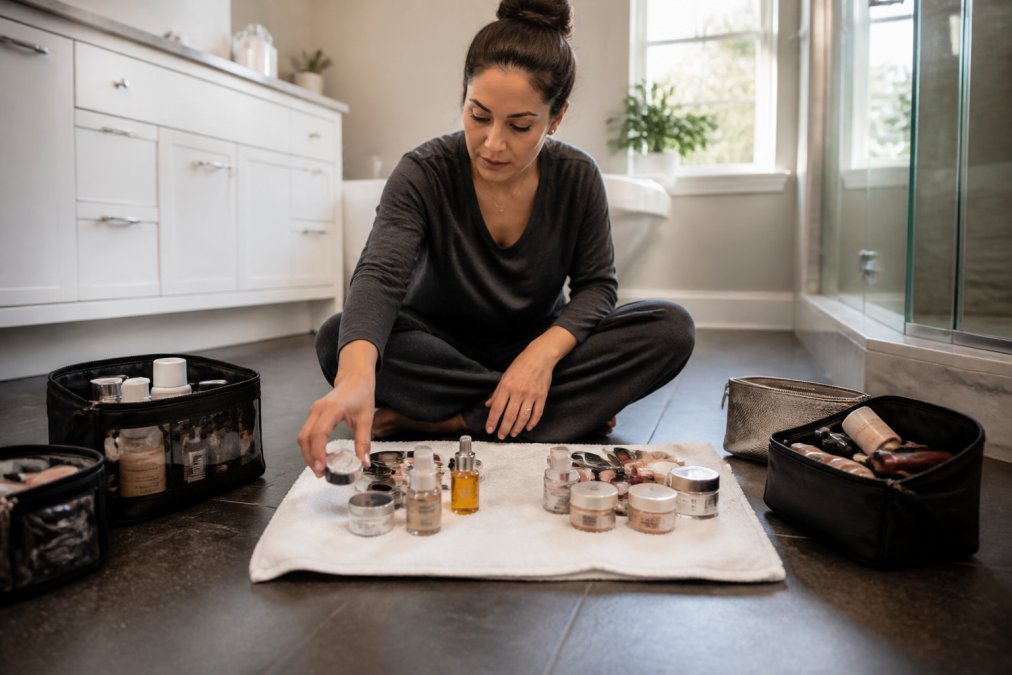
Empty your beauty collection onto a clean towel and sort everything into three piles:
- Keep: Products you use weekly that suit your skin type and haven't expired
- Toss: Anything past its expiration date, separated, or smelling off
- Donate or gift: Unopened items you'll never use
Most people find the "keep" pile is smaller than expected. That's the point.
Spotting Expired and Duplicate Products
A common mistake is holding onto products "just in case." Cream foundations separate after about a year (the FDA). Mascara should be replaced every three months (the FDA). If you own three near-identical nude lipsticks, keep the one you actually reach for.
Step 2: Build a Three-Step Skincare Foundation
A reliable skincare regimen comes down to three moves: cleanse, treat, protect. Everything else is optional. This foundation supports barrier health and keeps your complexion stable without a ten-bottle shelf.
Cleanse, Treat, Protect: The Non-Negotiables
- Cleanse: Remove makeup and sunscreen with a gentle cleanser or a water-activated cloth like the MakeUp Eraser Skincare Set, which lifts waterproof makeup with just water.
- Treat: Apply one targeted product, such as a serum or moisturizer suited to your skin's needs.
- Protect: Finish with broad-spectrum sunscreen every morning, rain or shine.
Why Fewer Active Ingredients Support Barrier Health
Stacking multiple active ingredients, like retinol plus acids plus vitamin C, often irritates skin rather than improving it. A simplified routine with one active at a time lets your skin adjust. Hydration and consistency matter more than variety.

The Anti-Aging Tinted Moisturizer SPF 30 by Chica Beauty combines moisturizer, tint, and sunscreen in one step, which trims two products from your morning lineup without sacrificing protection.

Step 3: Swap in Multi-Purpose Beauty Products
Multi-purpose products are the fastest route to a shorter routine. Instead of layering separate items, you use one product that does several jobs. The GO NATURAL® ALL-IN-ONE® Powder replaces foundation, blush, eyeshadow, lip color, concealer, highlight, contour, and brow color in a single compact, and it works across all skin tones without shade matching.
The 3-in-1 Eyebrow MULTI-TASKER follows the same logic: pencil, powder, and setting gel in one tool. Fewer products mean fewer decisions, and fewer decisions mean you actually stick with your routine.

| Old Routine Step | Multi-Purpose Swap | What It Replaces |
|---|---|---|
| Foundation + blush + bronzer | GO NATURAL® ALL-IN-ONE® Powder | 8 products |
| Moisturizer + tint + SPF | Chica Beauty SPF 30 Tinted Moisturizer | 3 products |
| Pencil + powder + brow gel | 3-in-1 Eyebrow MULTI-TASKER | 3 products |
| Makeup remover + wipes | MakeUp Eraser Skincare Set | 2 products |
Step 4: Learn How to Create a 10 Minute Makeup Look
A 10 minute makeup look works because it follows a fixed order. You aren't deciding what to do next; you're executing a sequence you already know. That's the difference between a rushed morning and a calm one.
The Five-Product Everyday Makeup Kit
Build your everyday makeup kit around five items:
- Tinted moisturizer with SPF
- All-in-one powder for cheeks and eyes
- Multi-tasking brow tool
- Mascara
- Lip color or tinted balm
Practice the sequence three mornings in a row. By practicing, many people can finish in under ten minutes.
Step 5: A Minimalist Makeup Routine for Beginners
A minimalist makeup routine for beginners should feel forgiving, not intimidating. Start with three products, not five. Add one item per week only if you notice something missing. This gradual approach prevents the overbuying cycle that fills drawers with unused items.
If you're coming from a full-coverage habit, expect the first week to feel "unfinished." Give it ten days before judging. Many find they prefer the lighter result once their skin adjusts.
Step 6: Cut Back on Exfoliation and Let Skin Rest
Exfoliating more than twice a week can strip the skin barrier and trigger dullness. Understanding the mechanism can help with habit adherence.
What Over-Exfoliation Actually Does
Your outermost skin layer is held together by a mix of lipids, ceramides, and dead cells that form a protective seal. Exfoliation removes some of those dead cells by design. Do it too often, and you start removing the lipids and ceramides underneath, the mortar, not just the bricks. The result is a barrier that loses water faster and lets irritants in more easily.
The visible signs are consistent: tightness after cleansing, stinging when you apply products that used to feel fine, flaking in patches, and a dull, waxy look that reads as 'needs more exfoliation' when it actually means the opposite. That misread is why so many people escalate their way into a worse barrier.
Physical vs. Chemical: Different Risks
- Physical exfoliants (scrubs, brushes, cleansing grains) remove cells through friction. The risk is mechanical, over-scrubbing causes micro-tears and redness, especially on the cheeks and around the nose.
- Chemical exfoliants (AHAs like glycolic and lactic acid, BHAs like salicylic acid) dissolve the bonds between dead cells. The risk is cumulative, you may not feel irritation on day one, but daily use over weeks thins the barrier.
Both can be used well. Neither should be used daily by most people.
A Workable Frequency
For most skin types, once or twice weekly is the ceiling, not the target. If you're using a retinoid, skip chemical exfoliants on those nights entirely, you're already accelerating cell turnover, and stacking the two is the most common route to a compromised barrier.
A simple weekly structure:
- One exfoliation night, mid-week.
- Retinoid on two or three other nights, spaced apart.
- Everything else is cleanse, moisturize, protect.
How to Pull Back and Reintroduce
If your skin feels tight, stinging, or flaky after cleansing, pause exfoliation entirely for one to two weeks. During that window, keep the routine to a gentle cleanser, a moisturizer, and sunscreen. Barrier health can recover with rest.
When you reintroduce, start at once every ten days for two weeks, then move to once weekly if skin stays calm. If irritation returns, drop back. The goal is the lowest frequency that still gives you the result you want, not the highest frequency you can tolerate.
Why This Matters More With Age
Skin thins and repairs more slowly over time, so the same exfoliation schedule that worked in your twenties can be too aggressive in your forties and beyond. Mature skin often does better with gentler acids at lower concentrations, or with physical exfoliation dropped entirely in favor of a soft washcloth. The principle is the same at every age, less often, and only when skin is calm, but the ceiling drops as you get older.
Step 7: Keep Your Routine Sustainable and Budget-Friendly
A sustainable beauty routine costs less over time because you buy fewer things and finish what you own. That's the standard line, and it's true, but it skips the part that actually changes behavior: knowing which categories are worth spending on and which are worth cutting. Budget-conscious simplification is a spending strategy, not just a product-reduction strategy, and almost no guide treats it that way.
The Cost-Per-Use Framework
Instead of asking what a product costs, ask what it costs per use. A $38 tinted moisturizer you wear five mornings a week for six months costs roughly 30 cents per wear. A $12 trend serum you use four times before it irritates your skin costs $3 per use. The cheaper sticker price is the more expensive product.
Run this math on your current shelf:
- List every product you own.
- Estimate how many times you actually used it in the last 30 days.
- Divide the price by that number.
- Anything above roughly $2 per use is a candidate to cut or finish-and-not-replace.
Many find their highest cost-per-use items are often those bought on impulse.
Where to Spend and Where to Save
Simplification doesn't mean buying the cheapest version of everything. A common pattern among people who successfully pare down is to concentrate spending in three categories and economize everywhere else:
- Spend on sunscreen. It's the one product with the strongest evidence behind daily use, and texture determines whether you'll actually wear it. A formula you like is worth the premium.
- Spend on one treatment active. Whether that's a retinoid, an acid, or a vitamin C serum, pick one and buy a version with a stable formulation rather than three half-strength products.
- Spend on a cleanser that doesn't strip. Barrier damage from harsh cleansing creates the redness and flaking that drives people to buy more corrective products.
- Save on mascara, lip color, and brow products. These get replaced frequently and don't need to be expensive to perform well.
- Save on tools you already own. A reusable makeup-removing cloth replaces disposable wipes indefinitely; the MakeUp Eraser Skincare Set is the version referenced earlier in this guide.
The One-Month Use Audit
Track what you actually reach for for 30 days. Put a small mark on each product every time you use it. At the end of the month, anything with zero marks goes in the donate-or-toss pile, and anything with one or two marks becomes a 'finish it, don't rebuy it' item. Buy only the categories that earned consistent marks going forward.
This can also be an effective way to manage buying habits.
Lowering Environmental Impact Without Losing Results
Fewer products mean less packaging, less shipping, and less waste, but the environmental case is strongest when you finish what you own rather than tossing a half-used bottle to 'start fresh.' Reusable options like a makeup-removing cloth replace disposable wipes entirely, and choosing refillable or multi-use formats cuts plastic over the long run. The environmental benefit and the budget benefit point the same direction: use it up, then replace it once.
Age-Specific Simplification
The principle holds at every stage, but the emphasis shifts:
- 20s: Protection and gentle cleansing. One active at most. The goal is preventing damage, not correcting it, so the routine can be genuinely minimal.
- 30s and 40s: Add one targeted treatment for the concern you actually have, texture, tone, or fine lines, and keep sunscreen daily. Resist adding a second active until the first has been consistent for at least eight weeks.
- 60+: Richer moisturizers and consistent SPF matter more, because skin produces less oil and repairs more slowly. A gentle cleanser, a moisturizer, a retinoid if tolerated, and sunscreen is a complete routine.
The number of steps stays small at every age. What changes is which one or two products carry the most weight.
Frequently Asked Questions
What are the essential steps for a minimalist beauty routine?
A minimalist beauty routine has three non-negotiables: cleanse, moisturize, and protect with sunscreen. From there, add one treatment product that targets your main concern, like a retinol or vitamin C serum. For makeup, a tinted moisturizer with SPF, a multi-purpose powder for cheeks and eyes, a brow product, mascara, and a lip color cover most days. This keeps your daily beauty routine under seven products while still supporting skin health and a polished complexion.
How long should a simplified daily beauty routine take?
A simplified routine can take 5 to 10 minutes from start to finish. Skincare, including cleansing, treating, and applying sunscreen, can take about 3 minutes. A 10 minute makeup look built on multi-purpose beauty products can cover the rest. The exact time depends on how many steps you keep, but if your routine regularly exceeds 15 minutes, you might consider cutting products that do not earn their place.
How do I choose multi-purpose beauty products that actually work?
Look for products that replace at least two steps you already do. A tinted moisturizer with SPF 30 handles hydration, coverage, and sun protection in one layer. An all-in-one powder can serve as foundation, blush, eyeshadow, and lip color. A 3-in-1 brow pencil combines color, powder, and gel. Check that each product suits your skin type before buying, and read reviews from customers with similar concerns so you are not guessing.
Is it better to have a complex or simple skincare routine?
A simple skincare routine can be effective and easier to stick with. Consistency matters more than the number of products. A cleanse, treat, protect routine with one or two active ingredients can support barrier health without overwhelming your skin. Adding more steps can increase cost, decision fatigue, and the chance of irritation. If your skin is thriving on three or four products, there may be no reason to add more.
Simplifying your daily beauty routine shouldn't require willpower or a spreadsheet. It requires the right starting point: a curated set of products that each do more than one job. sheshedbeauty4U built the Radiant Beauty Essentials collection around exactly that idea, pairing multi-tasking formulas with straightforward guidance so your morning routine takes minutes, not an hour. Search the collection and find the essentials that fit your skin, your schedule, and your budget.