
Best Anti-Aging Face Creams: A Pro Woman's Guide
Last Updated: October 29, 2026
Quick Summary
The best anti-aging face creams for professional women are chosen by concern: Wrinkle Repair Retinol Night Cream ($43.00) for fine lines, Soothing Anti-Aging Firming Cream ($49.00) for firmness, and Anti-Aging Tinted Moisturizer SPF 30 ($30.00) for busy mornings. Pick one cream for your main concern and use it consistently, since consistency beats intensity.
- Wrinkle Repair Retinol Night Cream contains 1% retinol and is used at night only.
- Soothing Anti-Aging Firming Cream suits early sagging along the jaw and neck on dry or reactive skin.
- Wrinkle-Smoothing & Firming Face Cream is the pick for sensitive skin that reddens easily.
- Wait two minutes after sunscreen before makeup to prevent pilling and patchy foundation.
- Reassess a new cream at four weeks, not four days, before deciding it failed.
Table of Contents
- Best Anti-Aging Face Creams at a Glance
- How We Selected These Anti-Aging Face Creams
-
The Best Anti-Aging Face Creams for Every Skin Concern
- For Fine Lines and Wrinkles: Wrinkle Repair Retinol Night Cream
- For Firmness and Elasticity: Soothing Anti-Aging Firming Cream
- For Hydration and a Radiant Glow: Sunrise Nourishing & Firming Cream
- For Sensitive Skin: Wrinkle-Smoothing & Firming Face Cream
- For a Day-to-Night Multi-Tasker: Anti-Aging Tinted Moisturizer SPF 30
- A Skincare Routine for Busy Professionals
- How to Layer Skincare Products for Work
- Dermatologist-Recommended Anti-Aging Creams: What to Look For
- Build Your Routine with sheshedbeauty4U
- Frequently Asked Questions
Best Anti-Aging Face Creams at a Glance
The best anti-aging face creams for professional women fit a real schedule: fast to apply, gentle enough for daily wear, and targeted at the concern you actually have. This guide breaks down anti-aging face creams by concern, explains how to choose a formula, how to layer them around a workday, and what to expect in the first weeks.
Here is the short version before the detail:
| Concern | Our Pick | Price | When to Use |
|---|---|---|---|
| Fine lines and wrinkles | Wrinkle Repair Retinol Night Cream | $43.00 | Night only |
| Firmness and elasticity | Soothing Anti-Aging Firming Cream | $49.00 | Morning and night |
| Hydration and glow | Sunrise Nourishing & Firming Cream | $32.00 | Morning |
| Sensitive skin | Wrinkle-Smoothing & Firming Face Cream | $32.00 | Morning |
| Day-to-night multitasking | Anti-Aging Tinted Moisturizer SPF 30 | $30.00 | Morning |
How We Selected These Anti-Aging Face Creams
We built this list around the constraints professional women actually face: limited morning minutes, makeup that has to hold through meetings, and skin that reacts badly to harsh actives.
Our criteria: does the formula name its key ingredients clearly (hyaluronic acid, niacinamide, peptides, retinol)? Is the texture workable under makeup or over a serum? Is the price fair for the jar size?
What most guides miss is that a face cream is only as good as the routine around it. The American Academy of Dermatology's guidance on skin care routines makes the same point: consistency and sun protection matter more than any single product.
The Best Anti-Aging Face Creams for Every Skin Concern
The right anti-aging face cream depends on your primary concern, not your age. Below are our picks by concern, with what each formula contains, how to use it, and who should skip it.
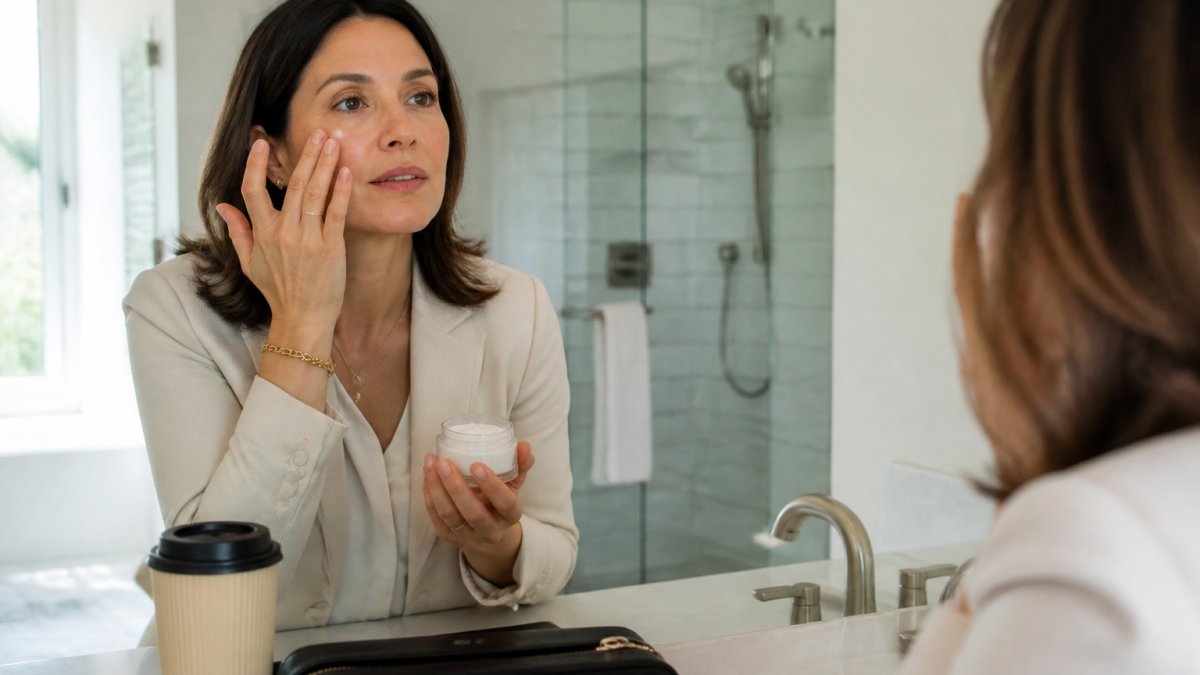
For Fine Lines and Wrinkles: Wrinkle Repair Retinol Night Cream
This night cream includes retinol while you sleep. The formula uses a 1% retinol concentration, which the listing notes makes it suitable for combination, dry, and sensitive skin.
Use it at night only, on a clean face and neck, avoiding the eye area. Use it at night only.
Wrinkle Repair Retinol Night Cream is the jar to start with if fine lines are your main concern.

For Firmness and Elasticity: Soothing Anti-Aging Firming Cream
The listing describes a formula built on green tea extract, apple stem cell extract, and papaya fruit powder, with ceramides and hyaluronic acid supporting the moisture barrier.
This one is described as ultra-soothing with a cocoon-like barrier finish. Apply morning and evening to clean skin.
Best for: Early sagging along the jaw and neck, especially on dry or reactive skin. Skip if: You want a lightweight gel texture in humid weather.
For Hydration and a Radiant Glow: Sunrise Nourishing & Firming Cream
This morning cream is built around hyaluronic acid, niacinamide, ceramides, and ayurvedic herbs, and the listing describes it as non-greasy with quick absorption, supporting elasticity while minimizing the look of fine lines.
It is described as absorbing quickly. Apply in the morning to face and neck, avoiding the eye area.
Best for: Dull, dehydrated skin that needs a fast morning step. Skip if: Your skin is already oily and you prefer a matte finish.
For Sensitive Skin: Wrinkle-Smoothing & Firming Face Cream
This formula is designed for sensitive skin. It contains three peptide technologies, including plankton extract, Argireline NP, and Eyeseryl B, plus hyaluronic acid, niacinamide, ginseng root, and helichrysum extract.
Best for: Sensitive skin that reddens easily but still wants firming benefits. Skip if: You are looking for a strong exfoliating effect.
Wrinkle-Smoothing & Firming Face Cream is our pick for reactive skin that has rejected stronger actives.

For a Day-to-Night Multi-Tasker: Anti-Aging Tinted Moisturizer SPF 30
Three steps in one product is the whole argument here. This tinted moisturizer combines broad-spectrum SPF 30, a blendable tint in three shades, and anti-aging moisturizers built on pomegranate and white tea extracts, vitamins A and E. It is paraben-free, phthalate-free, oil-free, and vegan.
For a professional schedule, the value is in the minutes saved and the consistency gained. The Skin Cancer Foundation's advice on daily sunscreen use is blunt on this point: daily SPF is non-negotiable for preventing premature aging.
Best for: Mornings with no time for separate moisturizer, SPF, and foundation. Skip if: You need full-coverage foundation or a matte finish.
Anti-Aging Tinted Moisturizer SPF 30 covers your base, your moisture, and your sun protection in one step.
Ageless Hydrating & Firming Face Cream – Brightening, Vegan & Sensitive-Skin →
A Skincare Routine for Busy Professionals
A skincare routine for busy professionals can be kept short in the morning and at night.
The mistake most guides make is treating "anti-aging" as one outcome. It is at least three, and they run on different clocks. Hydration is visible within hours and gone by the next cleanse.
Here is a workable structure, with realistic timing:
- Morning (about 4 minutes): Cleanse (30 seconds), apply a hydrating serum if you use one (20 seconds, then wait 30 seconds), apply your morning cream (30 seconds), apply SPF 30 or higher last (45 seconds). Wait two minutes before makeup so the sunscreen film sets and foundation does not pill.
- Evening (about 3 minutes): Cleanse (60 seconds, including a second pass if you wore tinted SPF or long-wear foundation), apply your treatment (30 seconds), apply night cream (30 seconds).
- Weekly: Add one exfoliating step only if your skin tolerates it. Skip it entirely on any night you use retinol.
Consistency tends to matter more than intensity when it comes to skincare routines.
If your mornings are truly compressed, the tinted moisturizer with SPF 30 collapses steps three and four into one. You lose full-coverage foundation, but you keep sun protection, which is the step most often skipped when time runs short.
Do not stack retinol, vitamin C, and an exfoliating acid in the same routine. Pick one active, use it consistently for four weeks, then decide whether to add a second. Redness and peeling are the fastest way to lose a month of progress.
Reassess at four weeks, not four days. If you see no change in texture or tone by week four, the product or the frequency is wrong, not your skin. If you see irritation, cut frequency to every other night before abandoning the product.
How to Layer Skincare Products for Work
Layering follows a simple rule: thinnest to thickest. Water-based serums go first, creams go after, and sunscreen always goes last in the morning.
Here is the sequence we recommend for a workday, with the practical details that decide whether it survives contact with makeup:
- Cleanse and pat dry. Do not scrub, a damp surface helps the next layer spread.
- Apply a hydrating serum, such as a hyaluronic acid and retinol serum, and let it absorb for 30 seconds. If the serum feels tacky after 30 seconds, you used too much; one pump is usually enough for the full face and neck.
- Apply your morning cream. Press it in rather than rubbing, and give it 60 seconds before the next step.
- Apply SPF 30 or higher as the final skincare step. Use about two finger-lengths for the face and neck, most people apply roughly half that, which is why daily SPF underperforms.
- Wait two minutes before makeup. This is the step people skip, and it is the one that prevents pilling and patchy foundation.
If you use a retinol night cream, do not layer it with other retinoids or strong acids.
The U.S. Food and Drug Administration's overview of cosmetic ingredients and labeling is a useful reference for understanding what is actually in a formula before you combine products.
If your foundation pills, the culprit is usually the wait time between sunscreen and makeup, not the products themselves. Two minutes of drying time fixes more makeup problems than switching foundations.
Do not apply a retinol night cream and then a tinted moisturizer with SPF in the same morning routine expecting the retinol to keep working. Keep retinol to night, and keep daytime focused on hydration and sun protection.
Layering is a compatibility problem, not a product-count problem. Three well-sequenced steps with proper wait times beat six steps applied in a rush.
Dermatologist-Recommended Anti-Aging Creams: What to Look For
Dermatologist-recommended anti-aging creams share a short list of ingredients, and you can screen a label for them in under a minute. The ingredient list matters more than the marketing copy on the front of the jar.
Look for these:
- Retinol or retinoids: The best-supported over-the-counter ingredient for fine lines and texture.
- Hyaluronic acid: Holds water in the skin for immediate plumping.
- Niacinamide: Supports the barrier and improves the look of uneven tone.
- Peptides: Signal ingredients that support firmness over time.
What to skip: heavily fragranced formulas if your skin is reactive, and any product that promises to erase wrinkles. No cream does that. A realistic expectation is softer texture, better hydration, and a gradual reduction in the look of fine lines over weeks, not days.
Build Your Routine with sheshedbeauty4U
Building a routine that survives a real schedule is the hard part, and it is where most skincare plans fail.
At sheshedbeauty4U, our Radiant Beauty Essentials selection is organized around exactly that idea: formulas with clear ingredient lists, workable textures, and prices that make consistency affordable.
Get started with sheshedbeauty4U and find the cream that matches your concern, your skin type, and your morning timeline.
Frequently Asked Questions
What ingredients should professional women look for in anti-aging creams?
Look for ingredients that address your main concern. Hyaluronic acid and ceramides support hydration and the moisture barrier, which matters if you sit in dry office air. Niacinamide helps with firmness and uneven skin tone. Retinol is the most proven ingredient for fine lines and wrinkles, but start with a lower concentration like the 1% in the Wrinkle Repair Retinol Night Cream if your skin is sensitive. Peptides, vitamin C, and antioxidants like green tea extract round out a solid formula. Check the label for these actives rather than relying on marketing claims.
How can I build a time-efficient anti-aging skincare routine for work?
Keep it to four steps in the morning: cleanse, treat (a serum with hyaluronic acid or niacinamide), moisturize, and apply SPF. The Anti-Aging Tinted Moisturizer Sunscreen SPF 30 combines sun protection with light coverage. At night, cleanse and apply a retinol cream like the Wrinkle Repair Retinol Night Cream, then moisturize if your skin feels dry. A consistent four-step routine you actually follow beats a ten-step one you skip.
Are expensive anti-aging creams worth the investment for professional results?
Price does not guarantee results. What matters is whether the formula contains proven actives at effective concentrations and suits your skin type. Several creams under $50 deliver solid ingredients: the Soothing Anti-Aging Firming Cream at $49 includes apple stem cell extract and ceramides, and the Sunrise Nourishing & Firming Cream at $32 has hyaluronic acid and niacinamide. More expensive options like the Restoring Wrinkle Treatment Face Cream at $76 add Coenzyme Q10 and a broader antioxidant blend. Match the price to the ingredients you need, not the other way around.
What is the best way to layer anti-aging products under makeup for the office?
Apply products thinnest to thickest: cleanser, then serum, then eye cream if you use one, then moisturizer, then SPF, then makeup. Wait about a minute between each layer so products absorb and your makeup does not pill. If you use a retinol product, save it for night because it can make skin more sun-sensitive. For daytime, a lightweight moisturizer like the Wrinkle-Smoothing & Firming Face Cream is an option. Finish with a tinted SPF to combine sun protection and coverage.
