
How to Choose Hydrating Face Cream for Dry Skin
Table of Contents
- Start With Your Skin Type, Not the Label
- The Best Ingredients for Dry Skin (and What to Skip)
- Moisturizer vs Cream for Dry Skin: Which One You Actually Need
- How to Layer Skincare for Maximum Hydration
- How to Read a Hydrating Face Cream Label Before You Buy
- Common Mistakes When Choosing a Hydrating Face Cream
- Frequently Asked Questions
Last Updated: September 16, 2026
Start With Your Skin Type, Not the Label
Choosing a hydrating face cream starts with identifying whether your skin is dry or dehydrated, because the two conditions need different formulas. This guide from sheshedbeauty4U walks through how to choose hydrating face cream for dry skin using ingredient lists, texture, and layering rather than marketing claims. According to the American Academy of Dermatology's skin care guidance, dryness reflects a lack of oil while dehydration reflects a lack of water, and a cream built for one may not fix the other.

Dry vs. Dehydrated: Why the Difference Changes Your Choice
Dry skin is a usually inherited skin type that produces fewer natural oils, so the lipid barrier struggles to hold moisture. Dehydrated skin is a temporary water-loss condition that can affect any skin type, including oily.
Read the two this way:
- Dry skin feels rough, flaky, and tight, and often looks dull year-round
- Dehydrated skin feels tight but may still be oily, and fine lines look deeper right after cleansing
The Best Ingredients for Dry Skin (and What to Skip)
The best ingredients for dry skin fall into three groups: humectants that pull in water, emollients that soften and fill gaps between skin cells, and occlusives that seal water in. A well-built hydrating face cream contains at least two of the three, and how they are ordered separates a cream that works from one that just feels nice.

Ingredients worth prioritizing:
- Ceramides to help rebuild the lipid barrier. Look for them paired with cholesterol and fatty acids, since the barrier is built from that trio rather than ceramides alone.
- Hyaluronic acid and glycerin to bind water in the upper layers. Glycerin is the more reliable workhorse; it holds water across a wider humidity range than hyaluronic acid.
- Fatty acids and plant oils such as borage seed and sea buckthorn to soften rough patches. Borage is high in gamma-linolenic acid, a fatty acid the skin uses directly.
- Panthenol and allantoin to calm the stinging that often accompanies a compromised barrier.
- Squalane, which mimics a lipid the skin already produces and absorbs without a heavy residue.
Humectants, Emollients, and Occlusives: What Each One Does
Each category solves a different half of the dryness problem, and most drugstore formulas lean on just one.
| Ingredient Type | What It Does | Example Ingredients | Best For |
|---|---|---|---|
| Humectants | Pull water into the skin | Hyaluronic acid, glycerin, aloe vera, panthenol | Dehydrated, tight skin |
| Emollients | Soften and smooth rough texture | Borage seed oil, squalane, fatty acids, neem oil | Flaky, rough patches |
| Occlusives | Seal water in and block loss | Petrolatum, shea butter, rich plant butters | Very dry, barrier-damaged skin |
How Ingredients Interact With the Rest of Your Routine
Ingredients do not work in isolation, they compete, stack, or cancel each other depending on order and timing.
Concentration and Order on the Label
The ingredient list runs in descending order of concentration, but the top five is a rough signal, not a magic number, a cream can list glycerin second and still be mostly water and filler. What matters more is whether barrier-repair ingredients (ceramides, cholesterol, fatty acids) appear before the preservative and fragrance block near the end.
Moisturizer vs Cream for Dry Skin: Which One You Actually Need
For dry skin, a cream is usually the better daily choice because it contains more oil and fewer water-based fillers than a lotion. "Moisturizer" describes a category; "cream" describes a texture and oil-to-water ratio within it.
Here is how the formats compare:
- Lotions are water-dominant, spread easily, and suit normal to slightly dry skin
- Creams carry more oil and hold hydration longer, which suits dry and very dry skin
- Ointments are almost entirely occlusive and work best on cracked or compromised areas
How to Layer Skincare for Maximum Hydration
Layering skincare for maximum hydration follows one rule: thinnest to thickest, always onto damp skin. Water-based products go first so they can absorb, and oil-rich creams go last to seal everything underneath.
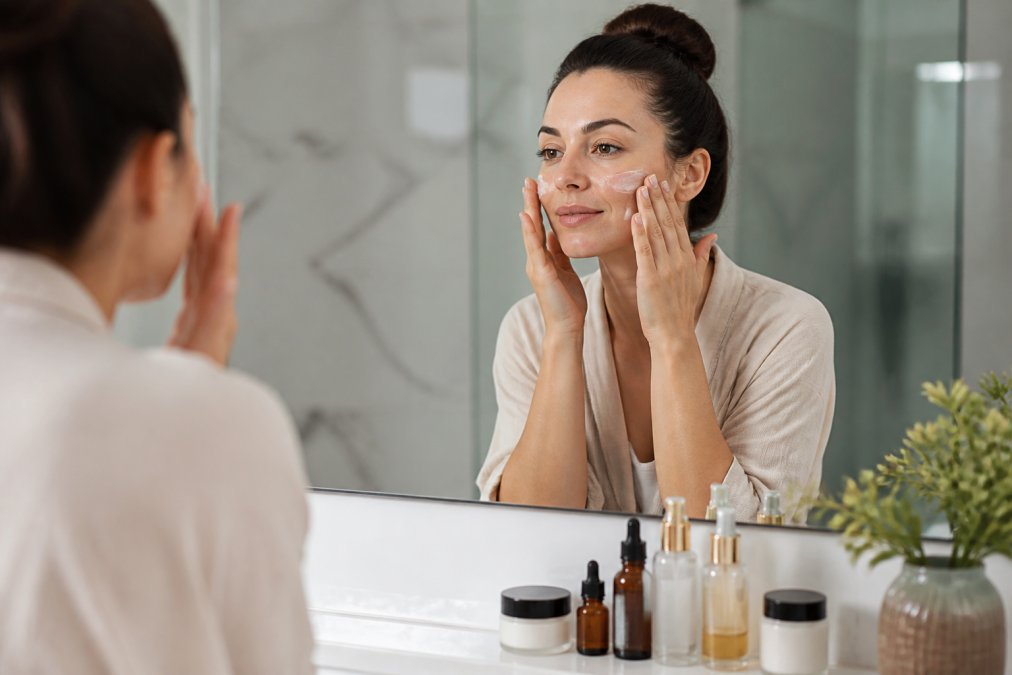
A practical order:
Rich Calming Cream for Dry, Stressed & →
- Cleanse with a non-stripping formula
- Apply a hydrating serum while skin is still damp
- Follow with an eye cream if you use one
- Seal with your hydrating face cream
- Add sunscreen in the morning as the final step
How to Read a Hydrating Face Cream Label Before You Buy
Reading a label takes about 30 seconds and saves you from repeating a bad purchase. Check four things: the first five ingredients, the barrier-repair block, the fragrance listing, and any testing claims.
Fragrance-Free, Hypoallergenic, and Non-Comedogenic: What These Terms Really Mean
These three terms get used interchangeably in stores, and they do not mean the same thing.
- Fragrance-free means no added fragrance, though a masking scent may still be present
- Hypoallergenic means the maker claims fewer allergic reactions, but there is no standard test behind it
- Non-comedogenic means the formula is designed not to clog pores, which matters if you are acne-prone alongside dry
Cream, Lotion, or Ointment: Matching Format to Skin and Season
Before you compare brands, compare formats. The same brand often sells the same actives in three textures, and picking the wrong one is the most common reason a product "doesn't work."
- Lotion is water-dominant, spreads easily, and suits normal to slightly dry skin or humid summer months. It absorbs in under a minute and rarely pills under makeup.
- Cream carries more oil and holds hydration longer. It suits dry and very dry skin and is the default for winter or air-conditioned offices.
- Ointment is almost entirely occlusive and works best on cracked or compromised areas, heels, cuticles, the corners of the nose during a cold. It is not a whole-face daily product for most people.
- Gel-cream sits between lotion and cream and is the compromise for combination skin that flakes on the cheeks but shines on the forehead.
Value for Money: What You Are Actually Paying For
Price and performance are only loosely related in this category. The expensive part of a cream is rarely the active ingredient, it is the packaging, the scent, the marketing, and the texture engineering. A few patterns hold up:
- Drugstore creams often use petrolatum, glycerin, and dimethicone as their backbone. These are among the most studied and effective ingredients available, and they cost very little. A basic barrier cream can outperform a luxury cream for straight dryness.
- Mid-tier creams add ceramides, niacinamide, and peptides, plus a more elegant finish. You are paying for texture and for actives that are harder to stabilize.
- Luxury creams add botanical extracts, proprietary blends, and a sensorial experience. Some of those extracts have real evidence behind them; many do not. The finish is usually the most noticeable difference.
A 60-Second Buying Checklist
- Does the first five ingredients include a humectant or a ceramide?
- Do ceramides, cholesterol, or fatty acids appear before the preservative block?
- Is fragrance absent, or low enough on the list that it is not the point of the product?
- Does the format match your skin and the season, lotion in summer, cream in winter?
- Is the packaging a pump or tube rather than an open jar?
- Can you patch test it for two nights before committing to a full face?
If a cream passes all six, it is worth a month-long trial. If it fails two or more, keep looking, there is almost always a better-matched formula at the same price.
Common Mistakes When Choosing a Hydrating Face Cream
The most common mistake is buying for the label instead of the skin in front of you. A cream marketed as "ultra-hydrating" can still be wrong if it is aimed at dehydrated oily skin rather than a dry skin type.
Other mistakes worth avoiding:
- Switching products every two weeks before a formula has time to work
- Layering three humectant serums with no occlusive on top
- Using a lightweight lotion in winter and blaming the brand when skin still flakes
- Skipping sunscreen, which lets UV damage undo barrier repair overnight
- Choosing a cream with a strong scent because it feels luxurious in the jar
Frequently Asked Questions
What is the most hydrating face cream for dry skin?
The most hydrating formulas combine humectants like hyaluronic acid and glycerin with occlusives such as ceramides and plant oils to pull in water and then seal it. A rich cream with a thicker consistency, like one built around hemp seed oil or borage seed oil, tends to outperform lightweight lotions on very dry skin. Look for fragrance-free, hypoallergenic options if your skin is also sensitive.
How can I tell if my skin is dry or dehydrated?
Dry skin lacks oil and feels rough or flaky year-round, while dehydrated skin lacks water and can feel tight or dull even if you have oily skin. Pinch a small area of your cheek: if it stays bunched rather than springing back, dehydration is likely. A hydrating face cream with humectants addresses dehydration, while a richer cream with emollients and occlusives targets true dryness.
Should I use a cream or a lotion for dry skin?
Creams contain more oil and fewer water-based ingredients than lotions, so they create a stronger barrier and slow transepidermal water loss. For dry or extremely dry skin, a cream is usually the better daily choice, especially at night. Lotions work for daytime if you layer them over a hydrating serum, but they may not hold moisture long enough on their own.
What ingredients should I avoid in a moisturizer for dry skin?
Alcohol denat, synthetic fragrance, and essential oils can strip the lipid barrier and trigger inflammation on already-compromised skin. Also skip formulas with high concentrations of exfoliating acids if your barrier is damaged. Patch testing any new hydrating face cream on your inner forearm for 24 hours helps you catch a reaction before applying it to your face.