
Choose Versatile Work Clothes for Travel: A 2026 Guide
Table of Contents
- Why Versatile Work Clothes Matter for Travel
- Build a Capsule Wardrobe for Business Travel
- Essential Wrinkle-Free Business Casual Travel Clothes
- Business Travel Outfit Ideas Using Your Core Pieces
- Master Fabric Selection for Travel Durability
- Pack Efficiently Without Checked Luggage
- Common Packing Mistakes to Avoid
- Frequently Asked Questions
Last Updated: October 2, 2026
Why Versatile Work Clothes Matter for Travel
Traveling for work demands versatile work clothes travel pieces that transition from boardroom to dinner, survive suitcase compression, and work across multiple climates. The real challenge is finding clothes that do multiple jobs at once. Every item must earn its luggage space by working in at least three different contexts.
This guide walks you through selecting versatile work clothes travel pieces that actually work, covering capsule wardrobe principles, fabric selection, and practical outfit combinations you can build in minutes.
Build a Capsule Wardrobe for Business Travel
Start with 8-10 core pieces maximum. Each piece should work with at least 3 other pieces, transition from day to evening, survive wrinkles, and fit comfortably over layers. The math: 5 tops × 3 bottoms × 2 layers = 30+ outfit combinations from just 10 pieces.
Start with a Neutral Color Palette
Choose 2-3 base neutrals (charcoal or navy, cream or warm white, camel or warm gray) and 1-2 accent colors that complement your skin tone. This means any top pairs with any bottom without mental math when you're tired and traveling.
Select Wrinkle-Resistant Fabrics
Wrinkle-resistant fabrics are non-negotiable for business travel. Choose ponte (stretchy knit blend), polyester blends (70% polyester, 30% natural fiber), wool blends (naturally shed wrinkles and resist odors), or technical nylon-spandex blends. Avoid pure linen and 100% cotton; choose linen-blends with synthetic fibers instead.
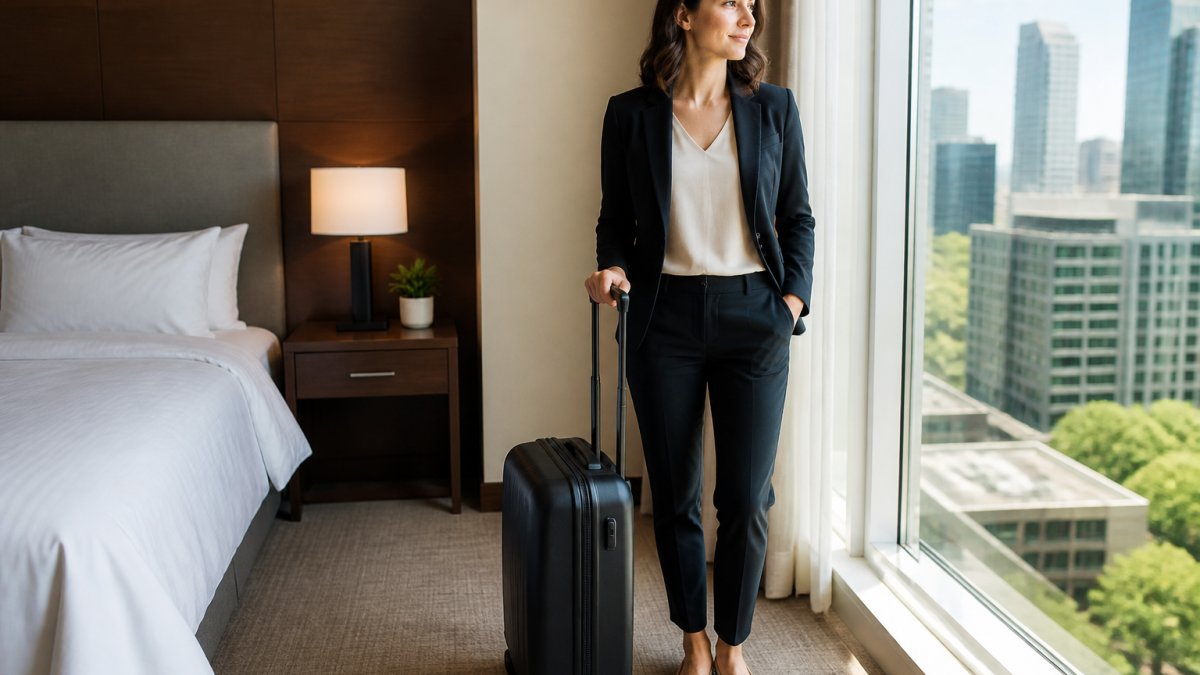
Essential Wrinkle-Free Business Casual Travel Clothes
Building wrinkle-free business casual travel clothes means selecting pieces that look intentional and polished without requiring a steamer. These are the foundation items every traveling professional needs.
Blazers and Structured Tops
Choose one structured blazer in navy or charcoal that fits your shoulders perfectly (unlined or partially lined, ponte or wool-blend, mid-hip length). Add 1-2 structured tops in neutral colors, a wrap top or peplum top creates structure without a jacket and transitions from office to dinner.
Bottoms That Travel Well
Choose ponte slacks (feel like dress pants, pack like athletic wear) or wool-blend trousers (professional and wrinkle-resistant). Pack two bottoms maximum: one in navy or charcoal and one in a lighter shade.
Footwear for Comfort and Professionalism
Pack two pairs maximum: one professional option (leather flats, low block heels, or structured loafers) and one that doubles as casual evening wear. Quality leather lasts longer than synthetic materials.
Business Travel Outfit Ideas Using Your Core Pieces
Once you've selected your core pieces, building outfits becomes simple. Today's business travel requires managing multiple dress codes in a single day: virtual meetings, in-person client visits, and evening events. Your wardrobe must flex across all three without requiring a complete outfit change.
The Hybrid Work Travel Reality
Hybrid work means dressing for remote work segments (video calls), in-person professional meetings, casual business social events, and leisure time. Your wardrobe must transition between these contexts without looking like you're wearing different outfits.
Building Combinations That Work Across Contexts
Map your actual travel schedule before packing. Example three-day client visit: Day 1: video call + office visit + team dinner. Day 2: full day meetings + casual evening. Day 3: morning meeting + afternoon free + client dinner. Build combinations that work across contexts: neutral blouse + blazer + ponte slacks covers video call, office, and dinner (remove blazer for dinner). Structured wrap top + wool-blend trousers + loafers works for meetings and casual dining. Neutral dress + blazer covers morning meeting, afternoon (remove blazer), and evening dinner (swap flats for heels).
Strategic Layering for Context Shifts
Layering signals context changes without changing clothes. A blazer makes an outfit professional; remove it for casual meals. A lightweight cardigan adds warmth and softens a professional outfit for evening. A scarf transforms an outfit without adding bulk, drape it for meetings, tie it for evening, wrap it as a shawl for casual time.
Outfit Combinations from a 10-Piece Capsule
A 10-piece capsule generates enough variety for a week: 1 blazer, 1 cardigan, 3 tops, 2 bottoms, 1 dress, 2 shoes, and accessories. Every top pairs with every bottom, and layering pieces (blazer, cardigan) shift formality level. This creates 10+ outfit combinations from the same pieces.
The Video Call Layer
Choose tops with structure and solid colors (read better on video), good shoulder fit (camera emphasizes this), and simple necklines. A neutral blouse in quality fabric looks professional on video and in person, doing double duty as both on-camera and in-person pieces.
Avoiding the "Costume Change" Problem
Avoid packing separate outfits for different contexts. Instead, choose pieces that layer smoothly and coordinate naturally. A cardigan should work over every top, your blazer should fit over every outfit, and your shoes should work with every bottom. This intentionality separates a travel wardrobe that works from one that creates stress.
Master Fabric Selection for Travel Durability
Fabric choice determines whether your clothes survive travel or deteriorate. Beyond wrinkle resistance, understanding fabric composition and performance standards helps you invest in pieces that actually deliver on durability claims.
Understanding Fiber Composition and Performance
Not all synthetic blends perform equally. The ratio of natural to synthetic fibers directly impacts how a garment behaves under travel stress.
Polyester-dominant blends (70% polyester or higher) recover quickly from compression wrinkles because polyester fibers have natural elasticity.
Wool-blend fabrics (including merino wool) naturally resist odors because wool fibers have a scale structure that sheds bacteria rather than absorbing sweat.
Nylon and spandex blends (often labeled as "technical" or "performance" fabrics) are engineered for moisture-wicking and shape retention.
Cotton-linen blends (minimum 40% synthetic content) offer the aesthetic of linen without severe wrinkling.
Evaluating Durability Claims
Check for pill resistance (high-quality fabrics resist pilling through tight weaving), colorfastness (synthetic fibers hold color better than natural fibers through hand-washing), and shrinkage ratings (less than 2% is safe for warm-water hand-washing). Synthetic blends shrink minimally, making them practical for travel.
Quick-Drying and Moisture Management
If you're hand-washing clothes in your hotel, drying time matters. Synthetic fibers dry 40-60% faster than natural fibers because they don't absorb water the way cotton does.
Polyester and nylon dry within 2-4 hours when hung in a hotel room with air conditioning or a window. Cotton blends take 6-8 hours. Pure wool can take 12+ hours and requires careful drying to avoid stretching.
Moisture-wicking is different from quick-drying. Wicking fabrics pull sweat away from your skin to the fabric surface, where it evaporates. Merino wool and technical synthetics both wick moisture.
Stain Resistance and Maintenance
Many quality fabrics now include stain-resistant treatments (often proprietary finishes from manufacturers). These treatments repel water and oil-based stains, giving you time to blot before the stain sets.
For travel, stain resistance buys you flexibility. A treated blazer can be worn multiple days without dry cleaning. A treated pair of ponte slacks resists the inevitable coffee spill or sauce splash that happens during business meals.
Check care labels for language like "stain-resistant," "soil-resistant," or specific brand names (Scotchgard, for example). These are worth the slightly higher price point for pieces you'll wear repeatedly while traveling.
Testing Fabric Before You Travel
Before packing any piece for business travel, test it the way you'll care for it on the road:
- Wash it in warm water (not hot) by hand or machine, using the method you'll use while traveling.
- Dry it by hanging in a warm room or using a hotel-style drying rack, not a machine.
- Evaluate for shrinkage (measure before and after), color fading, pilling, and shape retention.
- Wear it for a full day to assess comfort and whether it wrinkles during normal movement.
This test prevents discovering mid-trip that a fabric shrinks, pills, or fades, problems that ruin a travel wardrobe.
Pack Efficiently Without Checked Luggage
Packing efficiently means choosing pieces strategically so you fit everything in a carry-on.
The rolling method: Roll clothes instead of folding. This saves space and reduces creases.
Strategic layering: Pack items in the order you'll wear them.
Compression bags: These vacuum-seal your clothes, reducing volume by 30-50%. They're lightweight and worth the space they save.
Wear your bulkiest items: Wear your blazer and heaviest shoes on travel days.
Limit shoes: Two pairs maximum. Wear one, pack one. Shoes take disproportionate luggage space.
Use hotel amenities: Most hotels have irons, steamers, or pressing services.
Common Packing Mistakes to Avoid
Even experienced travelers make packing errors. Here's what to skip:
Packing "just in case" items. That extra blazer you might need, the formal dress for an event that might happen, these live in your closet, not your luggage. Pack for what you know you'll do.
Choosing comfort over professionalism. Travel fatigue tempts you toward athleisure. Resist this.
Forgetting your climate. Check the weather before packing. A heavy wool blazer in Miami is a mistake.
Overpacking neutrals. You don't need five neutral tops. Three is enough. That fifth top takes space and creates decision fatigue.
Ignoring fit. A piece that fits perfectly at home might feel different after travel.
Building a travel wardrobe that works requires intentionality, but the payoff is enormous.
Frequently Asked Questions
What fabrics are best for wrinkle-free business casual travel clothes?
Ponte, nylon blends, polyester, and merino wool are ideal for travel. These fabrics resist wrinkles naturally, dry quickly, and maintain their shape after packing. Avoid 100% cotton and linen, which wrinkle easily. Look for moisture-wicking properties in breathable fabrics to stay comfortable during long flights and meetings.
How many pieces do I need for a capsule wardrobe for business travel?
A solid travel capsule contains core pieces that mix and match to create multiple outfit combinations without overpacking. Focus on neutral colors and high-quality, wrinkle-resistant fabrics that mix and match easily.
What are some quick business travel outfit ideas for a three-day trip?
Day 1: Blazer + slacks + neutral blouse + loafers. Day 2: Sheath dress + cardigan + ankle boots. Day 3: Ponte pants + structured top + blazer + flats. Each outfit works for meetings and evening dinners. Layer with a lightweight cardigan or scarf to transition between climates and occasions without adding bulk to your luggage.
How do I keep work clothes wrinkle-free while traveling?
Roll items instead of folding to minimize creases. Place heavier items at the bottom of your carry-on and delicate pieces on top. Hang clothes immediately upon arrival or use a travel steamer for quick touch-ups. Choose quick-drying, wrinkle-resistant fabrics and avoid overstuffing your luggage to maintain professional appearance throughout your trip.