
How to Build a Capsule Wardrobe: 2026 Guide
Table of Contents
- Define Your Personal Style and Color Palette
- How to Find Clothes That Flatter Your Body Type
- Edit and Declutter Your Current Wardrobe
- Select Essential Staples and Transitional Pieces
- Build Outfits Using the Mix-and-Match Method
- Capsule Wardrobe Checklist 2026: Your Investment Pieces
- Care, Repair, and Cost-Per-Wear Analysis
Last Updated: August 26, 2026
Define Your Personal Style and Color Palette
The foundation of any successful capsule wardrobe starts with understanding who you are and what actually looks good on you. Gather inspiration from photos, social media, and street style that resonates with you. Notice patterns: Are you drawn to minimalist silhouettes or layered textures? Bold colors or neutrals? Structured pieces or flowing fabrics?
Narrow your observations down to 2-3 style descriptors that feel authentic, perhaps "modern minimalist with bohemian accents" or "classic professional with edge." These become your filtering system when considering new pieces.
Your color palette is equally critical. Choose 3-4 neutral base colors (typically black, white, gray, navy, beige, or cream) and 2-3 accent colors that complement your skin tone. Test these colors against your face in natural lighting. At sheshedbeauty4U, we recommend selecting colors that feel effortless when you wear them, colors that require minimal effort to coordinate but deliver maximum impact.
How to Find Clothes That Flatter Your Body Type
Understanding your body shape helps you recognize which silhouettes make you feel confident and comfortable. When clothing aligns with your natural proportions, you need less tailoring and fewer adjustments.
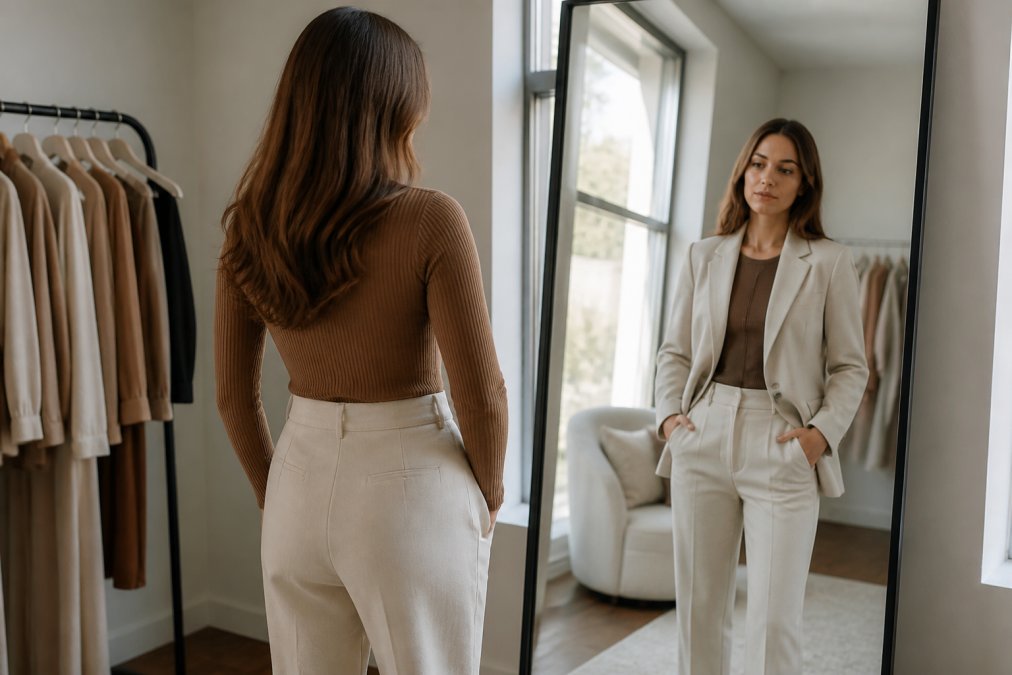
Identify where you carry weight and what proportions define your frame. Do you have broader shoulders or hips? Is your midsection defined? Are you taller or shorter in the torso? These observations determine which cuts, lengths, and styles will feel most natural on your body.
Certain silhouettes work universally well: A-line skirts, straight-leg pants with stretch, fitted blazers with tailored shoulders, and wrap tops all flatter multiple body types because they create balanced proportions (the American Academy of Dermatology). When building a capsule wardrobe 2026, prioritize pieces with these versatile silhouettes first.
The fit of a garment matters far more than the size on the tag. Clothes should skim your body, not cling or hang loosely. A piece that fits well in the shoulders but needs tailoring at the hem is a better investment than something that fits perfectly off the rack but pulls across your midsection.
Edit and Declutter Your Current Wardrobe
Before buying anything new, audit what you already own. Pull everything from your closet and be honest about what you actually wear. Create three piles: keep, donate, and maybe.
The keep pile contains pieces you've worn in the past three months, pieces that fit well, and pieces that align with your defined style and color palette. The donate pile is where most of the work happens. If you haven't worn something in a year, it doesn't fit, the color doesn't work with your palette, or it doesn't match your style, it goes. Holding onto "someday" clothes creates clutter and mental burden.
For the maybe pile, try each piece on. Does it fit well? Does it work with at least three other pieces in your keep pile? If you can't immediately see how to style it, it probably doesn't belong in a capsule wardrobe.
As you declutter, notice what remains. Do you have five black blazers but only one white button-down? That signals what's missing. Are most pieces rigid and structured? You might need more transitional pieces. This audit becomes your shopping blueprint.
Select Essential Staples and Transitional Pieces
Once your closet is edited, identify what's missing. Your capsule wardrobe needs two categories: essential staples that form the foundation, and transitional pieces that extend versatility across seasons and occasions.
Essential staples are the non-negotiable basics: well-fitting jeans (two pairs in different washes), neutral trousers, white and black t-shirts, basic long-sleeve tops, and a structured blazer. A white button-down works as a standalone top, layered under a sweater, worn as a shirt jacket, or dressed up for professional settings. That versatility makes it essential.
Transitional pieces extend your wardrobe's functionality without requiring complete seasonal swaps. Cardigans, lightweight sweaters, linen blazers, and denim jackets work across seasons. A cream cardigan worn over a summer dress in June works equally well layered over a long-sleeve top in September.
Investment pieces, higher-quality items in neutral colors, form the core. A well-made blazer, quality denim, a structured handbag, and classic footwear justify their cost through longevity and versatility. Accent pieces add personality: a patterned scarf, textured sweater, or piece in your accent color brings visual interest while maintaining cohesion.
Build your capsule around your actual life, not an imagined version of it. A corporate professional needs different staples than someone working from home.
Build Outfits Using the Mix-and-Match Method
The entire purpose of a capsule wardrobe is that pieces combine effortlessly. A true capsule wardrobe 2026 should yield at least 15-20 different outfit combinations from 20-30 pieces (peer-reviewed research).
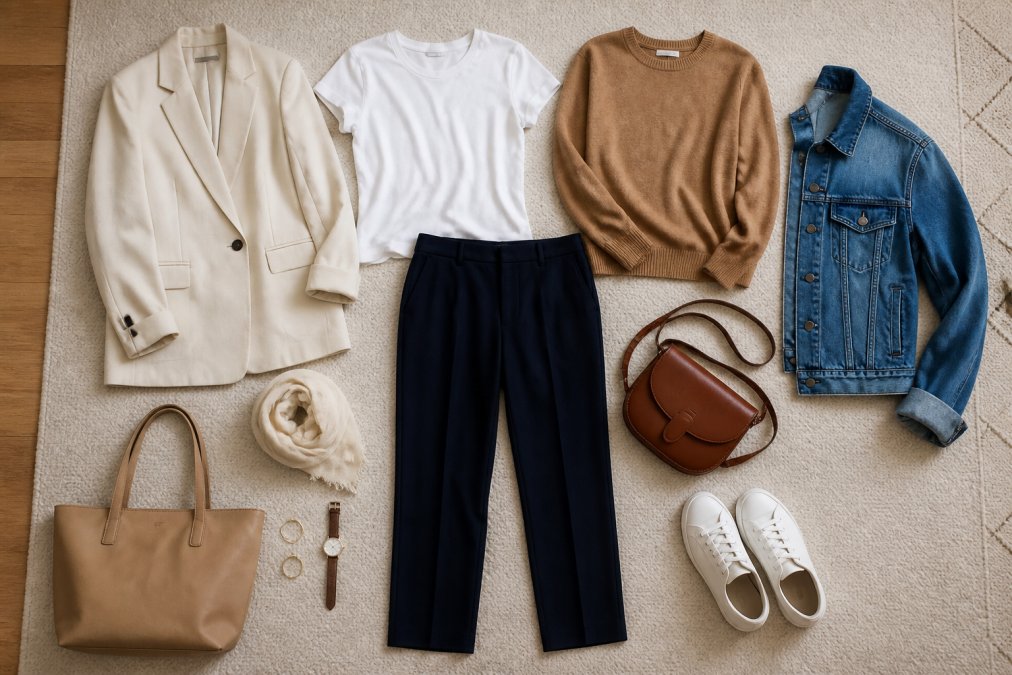
Start by testing combinations. Lay out your core pieces and see what works together. Your white t-shirt should work with your jeans, trousers, skirt, and blazer. Every piece should have at least three compatible partners. If a piece only works with one other item, it's creating a single outfit, not multiplying your options.
Document your combinations by taking photos of outfits you build or creating a simple list. This removes decision fatigue on busy mornings and shows you the versatility you've already created.
Layering is your secret weapon for extending a capsule across seasons and occasions. A sleeveless dress becomes three different outfits when layered with a t-shirt, cardigan, and blazer. Accessories amplify your combinations without cluttering your closet. A belt, scarf, or jewelry changes the entire feel of an outfit without adding bulk.
Capsule Wardrobe Checklist 2026: Your Investment Pieces
A functional capsule wardrobe 2026 doesn't require a specific number of pieces, it requires the right pieces. This checklist guides you toward building a capsule that serves your lifestyle while maintaining versatility and cohesion.
| Category | Essential Piece | Quantity | Why It Matters |
|---|---|---|---|
| Bottoms | Well-fitting jeans (neutral wash) | 2 | Foundational; works with most tops |
| Bottoms | Neutral trousers | 1-2 | Professional; extends versatility |
| Tops | White button-down | 1 | Most versatile piece; works dressed up or down |
| Tops | White t-shirt | 1-2 | Basic layering piece; works under everything |
| Tops | Black t-shirt | 1 | Neutral anchor; creates contrast |
| Outerwear | Structured blazer | 1 | Elevates any outfit; essential for professional settings |
| Outerwear | Cardigan or lightweight sweater | 1-2 | Layering essential; works across seasons |
| Outerwear | Denim or casual jacket | 1 | Transitional; softens formal pieces |
| Dresses | Neutral shift or A-line dress | 1 | Works casual or dressed up; minimal styling needed |
| Footwear | Neutral flats or loafers | 1 | Comfortable; works with most outfits |
| Footwear | Simple heels or booties | 1 | Professional; dresses up casual pieces |
| Footwear | Clean sneakers or casual shoes | 1 | Grounds casual outfits; adds comfort |
| Accessories | Structured handbag (neutral) | 1 | Professional; works across occasions |
| Accessories | Casual bag or tote | 1 | Everyday functionality |
| Accessories | Belt in neutral and accent color | 2 | Defines silhouette; adds visual interest |
Beyond this foundation, add pieces that reflect your lifestyle and personal style. Quality matters more than quantity. One well-made blazer worn 50 times is a better investment than five cheaper blazers worn occasionally.
Care, Repair, and Cost-Per-Wear Analysis
Building a capsule wardrobe is only half the equation. Maintaining those pieces determines how long they last and how much value you get from them. A piece worn 100 times costs significantly less per wear than an identical piece worn 10 times.
Proper care extends the life of your clothing dramatically. Wash items less frequently than you might think, most pieces don't need washing after a single wear unless visibly soiled. Air dry to extend fabric life. Fold rather than hang knit pieces to prevent stretching. Learn basic repair skills or develop a relationship with a tailor. A loose seam, missing button, or small hole are minor repairs that prevent pieces from being discarded.
Cost-per-wear is the metric that justifies investment pieces. Divide the price by the number of times you've worn or expect to wear the piece. A blazer costing $200 worn 100 times costs $2 per wear (the NIH). A trendy top costing $40 worn twice costs $20 per wear. Quality investment pieces suddenly look more economical than cheaper pieces you rarely wear.
Building a capsule wardrobe requires intentionality, but the payoff is substantial: mornings become simpler, your closet functions as a cohesive system, and you spend less time and money on clothing while looking more polished. At sheshedbeauty4U, we understand that effortless style comes from strategic choices, not impulse purchases. Our Effortless Style Collection is curated specifically to help you build a functional capsule with pieces that work together seamlessly. Start with the pieces that matter most, quality basics in your chosen color palette, and let your capsule grow intentionally from there. The result is a wardrobe that works as hard as you do.
Frequently Asked Questions
What is the 3-3-3 capsule wardrobe rule?
The 3-3-3 rule is a minimalist framework: 3 neutral base colors, 3 accent colors, and 3 patterns. This creates a curated collection where nearly every piece coordinates with others, maximizing outfit combinations from fewer items. It's ideal for building a capsule wardrobe that stays cohesive and versatile throughout seasonal changes.
How do I choose a color palette for my capsule wardrobe?
Start by identifying colors that complement your skin tone and hair color. Select 2-3 neutral base colors (black, navy, beige, gray, or white) that will anchor most outfits, then add 2-3 accent colors that reflect your personal style. Test colors against your face to see which ones make you look vibrant. Your palette should feel natural to you, not forced.
What essential pieces should every capsule wardrobe include?
Core investment pieces include a white button-down shirt, well-fitting jeans, neutral blazer, simple t-shirts, and a versatile sweater or knit. Add transitional pieces like a lightweight cardigan and neutral outerwear. Include basics in your chosen neutral tones, plus quality basics in your accent colors. Footwear should cover everyday wear, professional settings, and casual occasions.
How do I transition my capsule wardrobe between seasons?
Use layering and transitional pieces to extend your wardrobe across seasons. Lightweight cardigans, blazers, and long-sleeve shirts work year-round. Rotate heavier knits and outerwear in winter, and lighter fabrics in summer. Keep your core neutral pieces constant and swap seasonal accent pieces. This approach maximizes your capsule collection without requiring a complete wardrobe overhaul each season.
This article was written using GrandRanker