
How to Choose the Right Foundation Shade Online
Table of Contents
- Why Matching Foundation Online Is Tricky
- How to Determine Skin Undertone Before You Shop
- Know Your Skin Depth and Finish Preference
- The Best Online Foundation Shade Finder Tools
- How to Test Foundation Shade at Home
- Watch for Oxidation and Lighting Changes
- Know the Return Policy Before You Buy
- Your Next Step: Find Your Foundation Match
- Frequently Asked Questions
Last Updated: September 7, 2026
Finding your perfect foundation match without stepping foot in a store can feel like guesswork, but mastering how to choose the right foundation shade online comes down to understanding three things: your undertone, your skin depth, and how formulas behave once applied. At sheshedbeauty4U, we curate beauty essentials for busy women. The good news is that you can get a near-perfect match from your couch by learning to read your skin and using the smart tools brands now offer. Below, we’ll walk through a practical system that removes the guesswork, saving you time and money on returns.

Why Matching Foundation Online Is Tricky
The biggest obstacle isn't the lack of in-person testing; it's that screens distort color. Your phone or laptop display alters how a shade appears, making a warm-toned foundation look neutral or a light shade look deeper than it is. This is why many women end up with a product that looks fine in the bathroom mirror but wrong in daylight.
Another layer of complexity is that foundation isn't a single color. It interacts with your skin's natural oils, your skincare routine, and even the air, which means the shade you see in the bottle rarely matches the shade you see on your face hours later. Understanding this dynamic is the first step to making a confident online purchase.
How to Determine Skin Undertone Before You Shop
Skin undertone is the subtle hue beneath your skin's surface that remains constant regardless of tanning or seasonal changes (the American Academy of Dermatology). Identifying this is the most critical step, as it dictates whether you need a cool, warm, or neutral foundation. Getting this wrong is why a shade can look "off" even when the depth seems right.
The Vein Test and Jewelry Test
Two simple methods reveal your undertone without any special equipment. Look at the veins on the inside of your wrist in natural light. If they appear blue or purple, you likely have a cool undertone. If they look green, you have a warm undertone. If you see a mix of both, you're probably neutral.
The jewelry test offers a second data point. Consider whether gold or silver flatters your skin more. Warm undertones typically glow in gold, while cool undertones prefer silver. If both metals look good, you're likely neutral, which gives you the most flexibility when shopping. For those with olive undertones, often seen in Mediterranean or Latin heritage, you'll notice a slight green or yellow cast that can make both tests feel ambiguous.
The White Paper Test: A More Reliable Check
The vein and jewelry tests are good starting points, but they can be fooled by surface redness or a tan. A more reliable method is the white paper test. Hold a plain, white piece of paper next to your bare face in natural light. The paper eliminates color cast from clothing or walls. If your skin appears yellow or golden next to the white, you are warm. If it appears pink, rosy, or blue, you are cool. If you see no distinct cast, you are neutral. This test is more accurate because it isolates your skin's hue from environmental factors.
Using Color Theory to Correct an "Almost" Match
If your foundation pulls too pink or too red, you may have a cool mismatch. If your foundation looks too yellow or sallow, you may have a warm mismatch. Instead of returning the bottle, you can use a color corrector to adjust it. A tiny drop of a green color corrector neutralizes redness in a foundation that is too pink. A drop of a peach or yellow corrector warms up a shade that is too pale or ashy.
Know Your Skin Depth and Finish Preference
Once you know your undertone, you need to determine your skin depth, which is how light or dark your skin is on a spectrum from fair to deep. This is separate from undertone; you can be a fair cool or a deep cool. Most shade ranges are organized by depth first, then undertone, so knowing both narrows your options considerably.
Finish preference matters just as much as color. If you have dry skin, a dewy or satin finish will add luminosity, while oily skin benefits from a matte or soft matte formula to control shine. Choosing the right finish prevents the color from looking flat or greasy, which can alter the perceived shade. For a natural look, many women prefer a satin finish that sits between matte and dewy, offering a skin-like appearance that works well for work-to-evening transitions.
The Best Online Foundation Shade Finder Tools
Digital tools have evolved from simple quizzes to sophisticated color-matching systems. Many brands now offer a foundation shade finder that uses your answers about undertone, depth, and finish to recommend specific shades. These tools are a strong starting point, but they aren't infallible, so treat their suggestions as a shortlist rather than a final verdict.

How AI Shade Matching Works
AI shade matching typically uses a combination of your self-reported data and, in some cases, photo analysis. You may be asked to upload a selfie in natural light, which the algorithm scans to detect your undertone and depth. According to cosmetic chemistry research on pigment matching, these algorithms rely on color theory to map your complexion against a brand's specific shade range.
The limitation is that AI cannot account for oxidation or how a formula will sit on your unique skin texture. A shade that matches perfectly in a photo may still look different once blended, which is why the at-home test remains essential.
How to Test Foundation Shade at Home
Testing at home is straightforward if you follow a specific method. First, order samples or choose a brand with a generous return policy. When your product arrives, resist the urge to test it on your hand or wrist, as those areas have different pigmentation than your face.
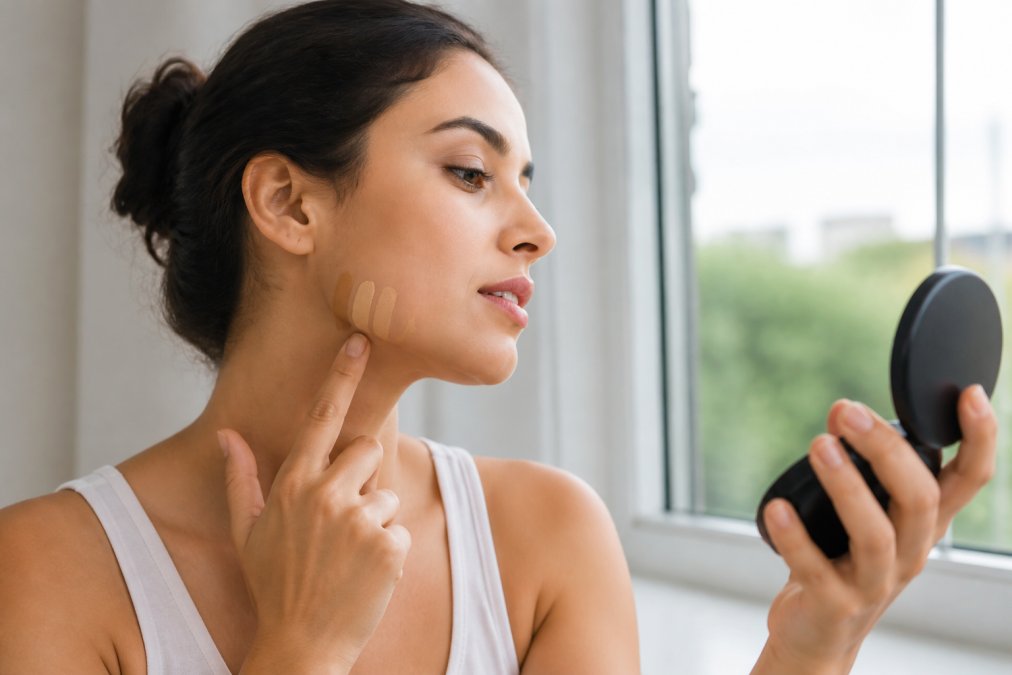
The Jawline Swatch Test in Natural Light
The jawline is the best testing area because it bridges your face and neck, ensuring the shade blends seamlessly. Apply a thin stripe of your top two shade candidates from your jaw down toward your neck. Do not rub them in immediately. Wait a few minutes to see if the formula oxidizes, then blend each stripe and step into natural light.
The correct shade should disappear into your skin, leaving no visible line. If one shade looks too pink or too yellow against your neck, you've likely misidentified your undertone. The American Academy of Dermatology's guide to choosing makeup recommends checking the match in daylight, as indoor lighting can cast a yellow or blue hue that distorts your judgment.
Watch for Oxidation and Lighting Changes
Oxidation is the chemical reaction that occurs when foundation reacts with the air and your skin's oils, causing the shade to darken or turn orange over time. Many women are caught off guard when a perfect match turns noticeably deeper within an hour of wear. To avoid this, test a shade for a full day before committing to a bottle.
The Mechanism Behind Oxidation
Oxidation is not a random defect; it is a chemical reaction between the pigments in the foundation and the oxygen in the air, often accelerated by the pH level of your skin and the presence of certain skincare ingredients. Foundations with iron oxides, the most common pigment, can shift when they interact with your skin's natural oils. Formulas that are water-based tend to oxidize less than oil-based ones because they have less vehicle for the reaction. If you use a vitamin C serum or other acidic skincare products underneath, you may accelerate oxidation. This is why a shade that looks perfect in the bottle can turn a dull orange on your face by mid-afternoon.
How to Test for Oxidation Before You Commit
You cannot see oxidation in a quick swatch. The only reliable method is to wear the foundation for at least four to six hours. Apply your normal primer and skincare underneath, then apply the foundation to your jawline. Check the color immediately, then check again after two hours, and again after four hours. Look for a deepening of the shade or a shift toward orange. If you see a significant change, that formula is not stable on your skin, regardless of how good the initial match looks. This full-day test is the single most effective way to avoid the "orange face" problem.
Lighting Temperature: The Hidden Variable
Lighting temperature also plays a significant role in how a shade appears. Warm, incandescent light adds a yellow glow that can make a cool foundation look acceptable, while fluorescent lighting adds a blue cast that can make a warm foundation look sallow. The problem is that most bathroom vanities use warm bulbs, which flatter almost any shade. You step outside into daylight, and the match falls apart. Always evaluate your match in natural daylight, ideally near a window, before making your final judgment.
The Three-Light Check
To be thorough, perform a three-light check. First, look at your swatch in natural daylight near a window. Second, check it under the warm, incandescent light of your bathroom. Third, check it under the cool, fluorescent light of your office or kitchen. A shade that looks good in all three lights is a keeper. A shade that only looks good in one light will be a problem in real-world settings. This method is especially important for women who work in offices with fluorescent lighting and then go out in the evening under warm restaurant lighting. Your foundation needs to survive all of them.
Know the Return Policy Before You Buy
Before you add that foundation to your cart, read the return policy carefully. Many online retailers allow returns on used cosmetics, but some do not, and others only offer store credit. Knowing the policy ahead of time protects you from being stuck with a product that doesn't work.
This is where shopping with a curated retailer offers peace of mind. At sheshedbeauty4U, we source high-performance formulas like our Luminous Foundation & Concealer Duo with mineral SPF that are designed to work across many skin tones, but we also understand that color matching is personal. Our selection includes foundations with 13 to 25 shades, offering flexibility that mass-market lines often lack.
Your Next Step: Find Your Foundation Match
Choosing the right foundation shade online is a skill that improves with each attempt. By identifying your undertone, understanding your depth, and testing patiently at home, you can achieve a flawless match that looks natural in every light. The process takes a bit of effort, but the payoff is a base that enhances your skin rather than masking it.
At sheshedbeauty4U, we've curated foundations that prioritize skin health with hydrating ingredients and mineral SPF. Explore our Radiant Beauty Essentials to find a formula that fits your skin type and lifestyle. Start your search today.
Frequently Asked Questions
Is it better to go lighter or darker with foundation?
Match your foundation to your neck, not your face. Your face is often slightly darker than your neck due to sun exposure. A shade that disappears on your jawline is the right one. If you are between two shades, choose the lighter one for a natural look, since you can always warm up the complexion with bronzer.
Should my foundation match my neck or face?
Your foundation shade should match your neck to avoid a visible line of demarcation. Test the shade along your jawline and blend it down toward your neck. The goal is a seamless transition. If your face and neck differ, prioritize the neck color for the most natural finish.
Can I use a foundation shade finder tool accurately?
Yes, but treat the result as a starting point. The best online foundation shade finder tools use your answers about undertone and skin depth to suggest shades, but they cannot account for oxidation or your specific screen settings. Verify the recommendation with a home swatch test in natural light before committing.
How do I find my perfect foundation shade?
Start by determining your undertone using the vein or jewelry test, then identify your skin depth level. Use an online shade finder tool for a shortlist of matches. Order samples or use the store's return policy to test the top contenders on your jawline in natural light. Watch the shade for a few minutes to check for oxidation.