
Why Curated Fashion Is Worth the Investment in 2026
Table of Contents
- The Real Cost of Cheap Clothes vs. Curated Fashion
- Cost Per Wear Calculation: The Formula That Changes How You Shop
- How to Build a Timeless Wardrobe That Actually Works
- Spotting Quality: Materials, Construction, and Hardware
- How to Find Clothes That Flatter Your Body Type
- Greenwashing vs. Real Sustainability in Fashion
- Start Your Curated Collection With These Staples
- Conclusion
- Frequently Asked Questions
Last Updated: September 6, 2026
The Real Cost of Cheap Clothes vs. Curated Fashion
The debate over why curated fashion is worth the investment usually stalls on the price tag. A $30 fast fashion dress seems like a bargain next to a $180 piece, but that math ignores how often you will replace it, repair it, or simply stop wearing it. Curated fashion is the practice of choosing fewer, higher-quality garments that work together across your lifestyle, rather than chasing every seasonal trend.
Busy professional women are tired of closets full of items that fall apart after a few washes or never quite fit right. Busy professional women are tired of closets full of items that fall apart after a few washes or never quite fit right. The real cost of cheap clothes is paid in time, frustration, and environmental waste, not just dollars.
Cheap garments often lose their shape quickly, fade after a few washes, and end up in a landfill within a year. When you divide the price by the number of wears, that bargain dress becomes the most expensive thing you own. This is where the cost per wear calculation changes how you think about every purchase.
Cost Per Wear Calculation: The Formula That Changes How You Shop
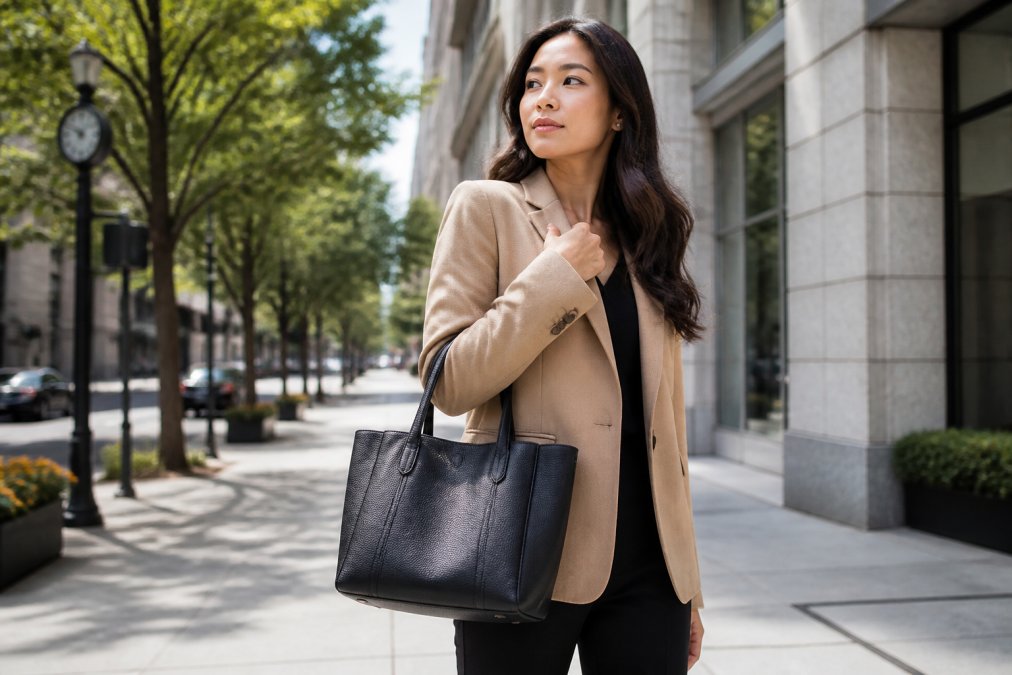
Cost per wear is the total price of an item divided by the number of times you wear it. A $180 tote bag worn 300 times costs 60 cents per wear (thebalancemoney.com). A $30 fast fashion top worn twice before it pills and fades costs $15 per wear. The expensive item is the cheaper one.
To calculate it honestly, estimate how often you will genuinely wear a piece over its lifetime. Consider the occasion, your rotation, and the garment's durability. This formula works for everything from handbags to blazers to beauty essentials you use daily.
| Item | Price | Estimated Wears | Cost Per Wear |
|---|---|---|---|
| Fast fashion top | $30 | 2-5 wears | $6-$15 per wear |
| Quality leather tote | $179 | 300+ wears | ~$0.60 per wear |
| Trendy dress | $50 | 3-4 wears | $12-$17 per wear |
| Timeless blazer | $150 | 150+ wears | ~$1 per wear |
The goal is to shift your spending toward pieces with a lower cost per wear, which naturally rewards quality craftsmanship and timeless design. Many shoppers find that a wardrobe audit reveals they wear only 20% of their clothes regularly, meaning 80% of purchases were poor investments.
How to Build a Timeless Wardrobe That Actually Works
Building a timeless wardrobe is less about buying a prescribed list of items and more about implementing a system that ensures each piece you own earns its place. The most effective approach combines a strategic foundation with a commitment to maintenance, because a 'timeless' piece only retains its value if it is cared for properly.
Step 1: Define Your Personal Uniform
Instead of starting with a generic list, begin with a data-driven audit. For two full weeks, track what you actually wear. Use a simple note on your phone or a tally in a notebook. At the end of the period, you will likely find that 80% of your outfits come from 20% of your closet. Those core items, the specific cut of jeans, the style of blazer, the type of shoe, define your personal uniform. Your goal is to invest in upgrading these workhorses, not in adding new, unused categories.
Step 2: Apply the 'Three-Way Mix' Rule
For any new piece to be considered a worthy addition, it must be able to create at least three distinct outfits with items you already own. This rule forces versatility and prevents the purchase of 'orphan' items that only go with one specific thing. A classic navy blazer, for example, can pair with jeans for the weekend, tailored trousers for a meeting, and a slip dress for an evening out. If a garment can't pass this test, it's a trend, not a staple.
Step 3: The Maintenance Contract
This is the step most guides miss. A curated wardrobe is a commitment to care. The financial logic of cost per wear collapses if a $200 garment is ruined by improper washing. Before you buy, consider the maintenance contract you are signing. Does the fabric require dry cleaning? Is the color prone to fading? A truly timeless piece should be easy to maintain. For most natural fibers, that means washing in cold water on a gentle cycle and laying flat to dry (the CDC). This simple habit prevents shrinkage, preserves color, and extends the life of the garment by years. For structured items like blazers, use a quality wooden hanger to maintain shoulder shape, and allow them to rest for 24 hours between wears to let the fibers recover.
Step 4: The 'One In, One Out' Policy
To prevent your curated collection from bloating back into clutter, adopt a strict 'one in, one out' policy. When you invest in a new pair of trousers, you must donate or sell an old pair that no longer serves you. This forces you to be honest about what you actually use and ensures your closet remains a functional, edited collection rather than an accumulation of past purchases.
Spotting Quality: Materials, Construction, and Hardware
Quality garments share identifiable traits, and learning to spot them prevents costly mistakes. Natural fibers like cotton, wool, silk, and linen breathe better and last longer than synthetics. Check the fabric content label and prioritize pieces with a high percentage of natural fibers.
Construction matters as much as material. Look for tight, even stitching, reinforced seams, and fabric that drapes well without pulling. Quality craftsmanship shows in the details: buttons sewn securely, zippers that glide smoothly, and linings that stay in place.
Hardware quality is often overlooked but critical, especially for handbags. A quality tote should feature sturdy zippers, solid clasps, and leather that develops a beautiful patina over time. The XL Sarah tote from sheshedbeauty4U exemplifies this, crafted from pebbled leather with a luxurious suede interior.

How to Find Clothes That Flatter Your Body Type
Understanding how to find clothes that flatter your body type is the difference between a closet that works and one that frustrates you. The goal is fit, not changing your body to fit the clothes.
Focus on proportions. Identify your shoulder-to-hip balance and choose cuts that create a harmonious silhouette. Tailoring is your best friend; a $20 alteration can transform a good garment into a great one.
Fit preferences vary by lifestyle too. If you transition from work to evening events, choose pieces with some stretch and classic cuts that accommodate movement. When you shop at sheshedbeauty4U, the Effortless Style Collection is designed with these real-world transitions in mind.
Greenwashing vs. Real Sustainability in Fashion
The term 'sustainable' has been so thoroughly co-opted by marketing departments that it has lost much of its meaning. To make informed choices, you need to move beyond buzzwords and understand the actual environmental mechanics of a garment's lifecycle.
The Hidden Cost of a T-Shirt
The most impactful metric is not whether a fabric is 'recycled' but how many times a garment is worn. Extending the life of a garment by just nine months can reduce its carbon, waste, and water footprints by around 20-30% (wrap.org.uk). This is the core argument for curation: a high-quality cotton shirt worn 150 times has a fraction of the environmental impact of a cheap synthetic blouse worn five times before it is discarded. The problem is not the initial production; it is the premature disposal.
The 'Wash and Wear' Test for Greenwashing
To distinguish a genuinely sustainable piece from a marketing gimmick, apply a simple 'Wash and Wear' test. A truly sustainable garment is designed to be durable. If a brand claims sustainability but the item is made from flimsy fabric that requires special, high-energy care, the claim is suspect. Ask these three questions:
- What is the fiber breakdown? Look for a high percentage of natural, biodegradable fibers like organic cotton, linen, or wool. Be wary of 'vegan leather,' which is often just plastic (polyurethane) that will not biodegrade.
- What is the care label? A garment that requires dry cleaning has a higher environmental footprint than one that can be washed in cold water. The most sustainable garment is one you can easily care for at home.
- What is the construction? Look at the seams. A garment with flat, reinforced seams will last longer than one with simple, overlocked edges. Durability is the ultimate sustainability metric.
The 'Certification' Shortcut
While certifications are not perfect, they provide a baseline of accountability. Look for third-party verified labels like the Global Organic Textile Standard (GOTS) for organic fibers or the Fair Trade Certified seal for ethical manufacturing. These certifications require audits and provide a paper trail. If a brand only uses vague terms like 'eco-conscious' or 'green' without a specific certification or data on its website, that is a red flag.
Start Your Curated Collection With These Staples
Building your curated fashion collection begins with a few high-impact pieces. Start with one quality handbag that elevates every outfit. The THE XL SARAH LARGE BELT TOTE BAG at $179 holds everything you need while adding polish to work and weekend looks.
Add a classic blazer, well-fitted dark jeans, a silk-blend blouse, and versatile shoes. These five pieces create a foundation you can build on for years. As you add items, maintain your cost per wear discipline and prioritize natural fibers and solid construction.
Beauty essentials follow the same principle. A curated selection of high-performance products, like the mineral blush and Lip Lusher offered at sheshedbeauty4U, replaces a drawer of half-used items. Quality formulas with nourishing ingredients work better and last longer.
Conclusion
The case for curated fashion rests on financial sense, environmental responsibility, and daily confidence. Buying fewer, better pieces lowers your cost per wear, reduces waste, and ensures you always have something that fits and flatters.
At sheshedbeauty4U, we curate our Effortless Style Collection and Radiant Beauty Essentials to support this approach. Every item is chosen for quality, versatility, and longevity. Start your curated collection today and experience the difference that intentional choices make.
Frequently Asked Questions
What is the 3-3-3 rule in fashion and how does it relate to curated style?
The 3-3-3 rule is a styling method where you build an outfit from just 3 clothing items, 3 accessories, and 3 pairs of shoes. It forces you to focus on versatile pieces that mix and match easily. This approach aligns with curated fashion because it prioritizes a small number of high-quality, flexible items over a closet full of rarely worn clothes. The goal is to create multiple looks with fewer, better pieces, which naturally supports a more intentional and sustainable wardrobe.
How does the cost per wear calculation help justify investing in quality pieces?
The cost per wear calculation divides an item's price by the number of times you wear it. For example, a $179 tote worn 200 times costs about $0.90 per wear, while a $50 fast-fashion bag worn 10 times costs $5 per wear. This formula reveals that higher initial prices often deliver better long-term value when the item is durable and versatile. Curated fashion focuses on pieces with classic designs and quality construction that you will wear for years, making the investment worthwhile.
What are the hallmarks of timeless, investment-worthy fashion?
Timeless, investment-worthy fashion focuses on classic silhouettes, neutral colors, and high-quality materials rather than seasonal trends. Look for natural fibers like cotton, wool, and leather, which hold up better than synthetics. Examine the garment construction: check for tight, consistent stitching, reinforced seams, and quality hardware like zippers and buttons. A timeless piece should fit well and flatter your body type, meaning it will remain a wardrobe staple for years, not just for one season.
How does curated fashion contribute to a more sustainable lifestyle?
Curated fashion reduces waste by encouraging you to buy fewer, better-made items that last longer. The fashion industry's environmental impact is driven by the production and disposal of cheap, low-quality clothing. By choosing durable pieces from ethical brands, you lower your personal contribution to textile waste. This approach, often called slow fashion, also supports a circular economy where clothes are worn more often and eventually resold or recycled, reducing the demand for new production.